
Date : 11/20/2026
Disclaimer: This article is for general educational purposes only and isn’t a substitute for professional medical advice, diagnosis or treatment. Only your physician and radiology team can decide whether gadolinium contrast is right for you. Before your scan, tell them if you have kidney disease, have had a past reaction to contrast, or are pregnant or breastfeeding. If you have a medical emergency, call your local emergency number right away.
Table of Contents
Getting sent for a medical scan usually brings up a lot of questions. You spend weeks waiting for an appointment, you finally explain your symptoms, and the next thing you know, someone is handing you a pamphlet about intravenous injections. If your doctor casually mentioned that you need a scan “with dye,” feeling a little uneasy is a completely normal reaction.
In a clinical setting, you’ll likely hear the term iodinated contrast media thrown around by the nurses and techs. It sounds incredibly intimidating. Really, it’s just a specialized, temporary liquid that helps the radiologist see exactly what’s going on inside your blood vessels, organs, and soft tissues. Without it, some scans just look like a blurry, gray weather map. With it? The internal structures light up beautifully, taking the guesswork out of your diagnosis.
Book an appointment
The Basics: What is IV Contrast Made Of?
People standing in front of an imaging machine always ask the same logical question: what is iv contrast made of? You’d be forgiven for thinking it’s some highly volatile chemical cocktail. It isn’t. The main ingredient is right there in the name—iodine. Yes, it’s very similar to the element added to common table salt, though structurally adapted for heavy medical use.
Pharmaceutical companies take iodine and chemically bind it to non-toxic, organic ring structures. Why? Because pure iodine wouldn’t mix well in your veins. Binding it to these organic molecules allows the liquid to travel safely through your bloodstream without causing massive irritation. Over the last two decades, medical science has shifted almost entirely to “non-ionic” versions of these fluids. Non-ionic simply means the liquid has a thickness and particle concentration very close to human blood, which drastically cuts down on adverse side effects.
How Iodinated Contrast Media Actually Works
So, what happens the exact second the injection starts? Because iodinated contrast media is incredibly dense, it acts like a temporary roadblock for x-rays.
Standard x-ray beams easily pass right through muscle, fat, and air. But when they hit that dense iodine flowing through your veins, they bounce back. That physical reaction makes your blood vessels, kidneys, liver, or heart glow bright white on the radiologist’s monitor. Doctors rely heavily on this intense visual contrast to spot blocked arteries, microscopic tumors, or internal bleeding that plain, unenhanced scans completely miss.
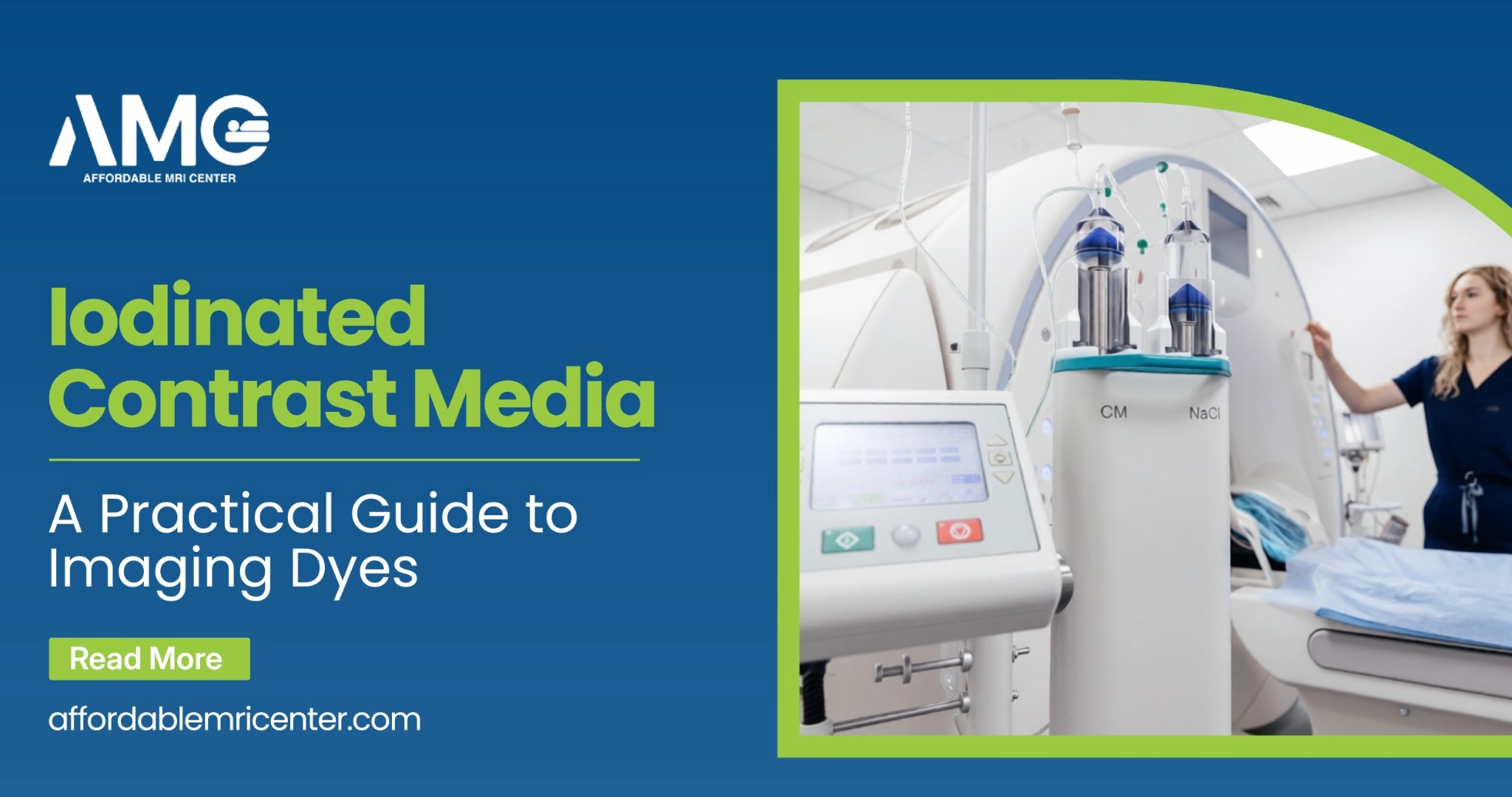
When you sit on the scanning table, a technician places a small IV line, usually in the crook of your arm or the back of your hand. That line connects to a machine called a power injector. The power injector pushes the fluid into your vein at a highly specific speed perfectly timed with the spinning of the scanner. The dye rushes up your arm, passes through the right side of your heart, moves into your lungs, and then pumps out to the rest of your arteries. All of this happens in literally seconds.
The physical experience of receiving the dye is unique. You might feel a sudden, intense hot flash spread through your chest and rush all the way down to your legs right after the iv contrast dye goes in. A lot of patients say it feels like they just wet their pants. Some people even taste a strong metallic flavor in the back of their throat, almost like sucking on a penny. Don’t panic. Both of these sensations are completely harmless vascular reactions and usually vanish in under a minute.
Table 1: Common Imaging Fluids Compared
Let’s break down the most common imaging fluids you might encounter depending on your prescribed test.
| Scan Type | Main Active Ingredient | What It Actually Does Inside the Body | Common Physical Sensations |
|---|---|---|---|
| CT / X-Ray | Iodine | Physically blocks x-rays to create bright white images. | Intense warm flush, metallic taste. |
| MRI | Gadolinium | Temporarily changes the magnetic charge of water molecules. | Slight cooling feeling in the arm. |
| Ultrasound | Microbubbles | Bounces sound waves back to the handheld probe. | None. Unnoticeable. |
| GI Series | Barium | Coats the stomach/intestines to block x-rays. | Chalky texture, slight bloating. |
Gadolinium vs Iodine Contrast: The Big Mix-Up
Here is where things get tangled up for a lot of patients with iodinated contrast media. CT scanners and MRI machines look virtually identical to the untrained eye. They are both big, noisy tubes with a sliding table. Because they look so similar, people just assume they run on the exact same technology and use the exact same injections. They absolutely don’t.
This misunderstanding naturally sparks the whole gadolinium vs iodine contrast debate in online health forums. CT machines use ionizing radiation—x-rays. That means they physically need dense iodine to block the radiation beams. MRI machines operate on a completely different planet of physics. They use massive, super-cooled magnets and radio waves. Because an MRI doesn’t use a single x-ray, iodine is absolutely useless inside one.
MRI scanners basically turn your body into a giant, temporary compass. The powerful magnets align the protons in your water molecules, and then radio frequency pulses knock them out of alignment. As the protons snap back into place, they emit signals that a computer turns into a 3D picture. Gadolinium speeds up how fast those protons snap back, making tumors, nerve damage, or torn ligaments stand out sharply against healthy tissue. It’s an entirely different mechanism of action.
Instead, MRIs use gadolinium, a rare-earth metal that reacts beautifully to magnetic fields. Patients constantly search the internet for the phrase MRI contrast iodine. It’s a complete myth. Or they’ll flat-out ask the radiology tech: does MRI contrast have iodine? No, never. If you have a documented iodine allergy, it has zero bearing on your ability to safely get an MRI. The two chemicals aren’t even in the same biological family.
Book your Appointment
Preparing for Iodinated Contrast Media
Before you even get near a scanner room, several safety checks have to happen behind the scenes. Filtering out iodinated contrast media requires healthy kidneys. If you’re over the age of 60, have a history of diabetes, or struggle with high blood pressure, the clinic will run a quick, mandatory blood test.
They are checking your eGFR—basically a numerical grade for how well your kidneys filter waste on a daily basis. This eGFR number tells the doctor how many milliliters of blood your kidneys can filter per minute. A normal score is usually above 60. If your number dips too low, putting a heavy, dense fluid through those already-struggling filters is a bad idea. It can cause a condition called contrast-induced nephropathy, which is a temporary but serious drop in kidney function. If those numbers look sluggish, the radiologist will simply skip the dye entirely and try a different imaging approach to protect your renal system from unnecessary stress.
The Aftermath: How Long Does Iodinated Contrast Media Stay in Your System?
If a concerned friend ever asks you what dye is used for CT scan appointments, you now know it’s iodine-based. But where exactly does it go once the scanner turns off and you go home?
Your body immediately recognizes the fluid as a waste product. The kidneys kick into overdrive, pulling the heavy liquid out of your circulating blood and pushing it straight into your bladder. So, how long does ct contrast stay in your system? For a healthy adult with normal kidney function, practically all of it is completely gone within 24 hours.
The medical half-life of the dye is roughly two hours. That means every two hours, half of whatever is currently left in your body gets flushed down the toilet. Drinking plenty of clear water dramatically speeds this up. You want those kidneys working hard, flushing everything out fast so they don’t have to strain against the dense fluid.
Table 2: Estimated Processing Timeline
| Time Since Injection | Dye Remaining in Body (Healthy Kidneys) | Recommended Patient Action |
|---|---|---|
| 2 Hours | 50% | Drink 1-2 large glasses of water. |
| 4 Hours | 25% | Continue normal fluid intake. |
| 12 Hours | ~2% | Resume completely normal activities. |
| 24 Hours | 0% | None. The fluid is gone. |
Conclusion
Frequently Asked Questions
The only real pain is the initial needle poke for the IV line, usually placed in your arm or hand. The fluid itself doesn’t burn when it enters the vein, though the heavy rush of warmth can definitely catch you off guard if you aren’t expecting it. The power injector machine pushes the fluid very quickly, which is why that warm flush hits so fast.
Usually, yes. Fasting for two to four hours prior is standard protocol at most imaging centers. Having an empty stomach heavily reduces the very small chance of nausea or vomiting when the thick dye first hits your bloodstream. You can usually drink clear liquids up until the appointment, but always follow your specific clinic’s instructions.
The fluid does cross the placenta, meaning it reaches the baby. While no hard clinical evidence points to it causing birth defects or harming a developing fetus, doctors always play it safe. They only use it on pregnant patients in absolute emergencies—like trauma or suspected blood clots—where the mother’s immediate life depends on getting a clear scan.
This is an old medical myth that stubbornly refuses to die. A shellfish allergy absolutely does not mean you’ll react to imaging dye. The specific proteins in the seafood trigger those food allergies, not the iodine itself. You consume trace amounts of iodine every day in normal food without issue.
Severe reactions are incredibly rare today thanks to modern non-ionic formulas. If you do have a mild reaction—like a few hives or feeling itchy—the radiology team has antihistamines right there in the room. If you have a known history of severe dye allergies, doctors can prescribe a premedication regimen of oral steroids and Benadryl to take a day before the scan, which reliably blocks the immune response.
References
https://my.clevelandclinic.org/health/diagnostics/21593-estimated-glomerular-filtration-rate-egfr
https://pubmed.ncbi.nlm.nih.gov/2105923/

Dr. Samiullah Kundi
Neurology, Pain Medicine & Neuroimaging
Dr. Kundi is a board-certified neurologist and pain medicine specialist who relies on advanced MRI findings to diagnose and treat complex conditions of the brain, spine and peripheral nerves. He is certified by the American Board of Psychiatry and Neurology (ABPN) in Neurology and Clinical Neurophysiology, the American Board of Pain Medicine (ABPM) and the American Board of Integrative Holistic Medicine (ABIHM). He believes precise, timely imaging is the foundation of effective care, and that belief led him to support Affordable MRI Center’s mission of making high-quality diagnostic MRI accessible and affordable.